

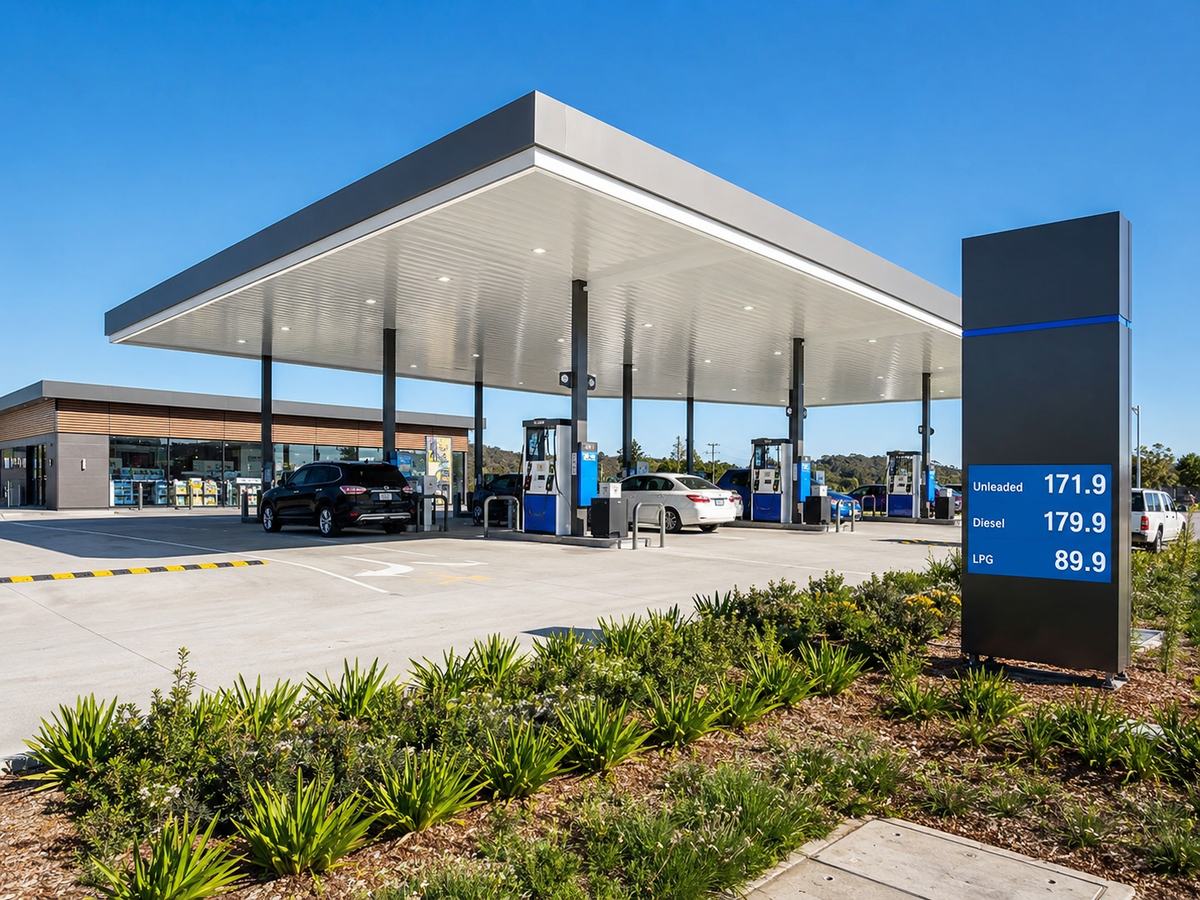
The scenario
“With specialty assets, the lease and the tenant covenant do the heavy lifting.”
— The Australian Property Development Handbook
A developer is delivering a service station with a convenience store and a QSR pad, pre-committed to an established fuel operator on a long lease. Unlike for-sale product, leverage is set against the completed investment value implied by that lease — roughly $6.55m, capitalised from about $360k p.a. of net rent at a 5.5% yield — on a $5.8m cost base.
How we structured it
| Total development cost | $5.80m |
|---|---|
| Net rent (p.a.) | $360k |
| Completed value (5.5% yield) | $6.55m |
| Senior debt | $3.93m |
| Developer equity | $1.87m |
| Brokerage — BluCow (indic.) | $39,300 + GST |
| Senior rate | 8.50% |
|---|---|
| Loan to value (LVR) | 60.0% |
| Loan to cost (LTC) | 67.8% |
| Development margin | $0.75m |
| Margin on cost (RoC) | 12.9% |
| Return on equity (RoE) | 40% |
How our fee works: BluCow charges per facility — from 1.0% + GST on the senior facility (minimum $20k + GST), tapering to 0.75% above $10m. Where a lender also pays BluCow a commission on a facility, it is credited against the fee shown.
This case study is hypothetical and illustrative — figures depend on the project, security, lease and lender.
The outcome
Leverage follows the leased investment value, and the submission is built around the lease and covenant evidence — not just build cost. It is a single senior facility, funded to hold or trade the completed asset; on completion it refinances onto an investment loan or sells to a passive investor at the capitalised value.