

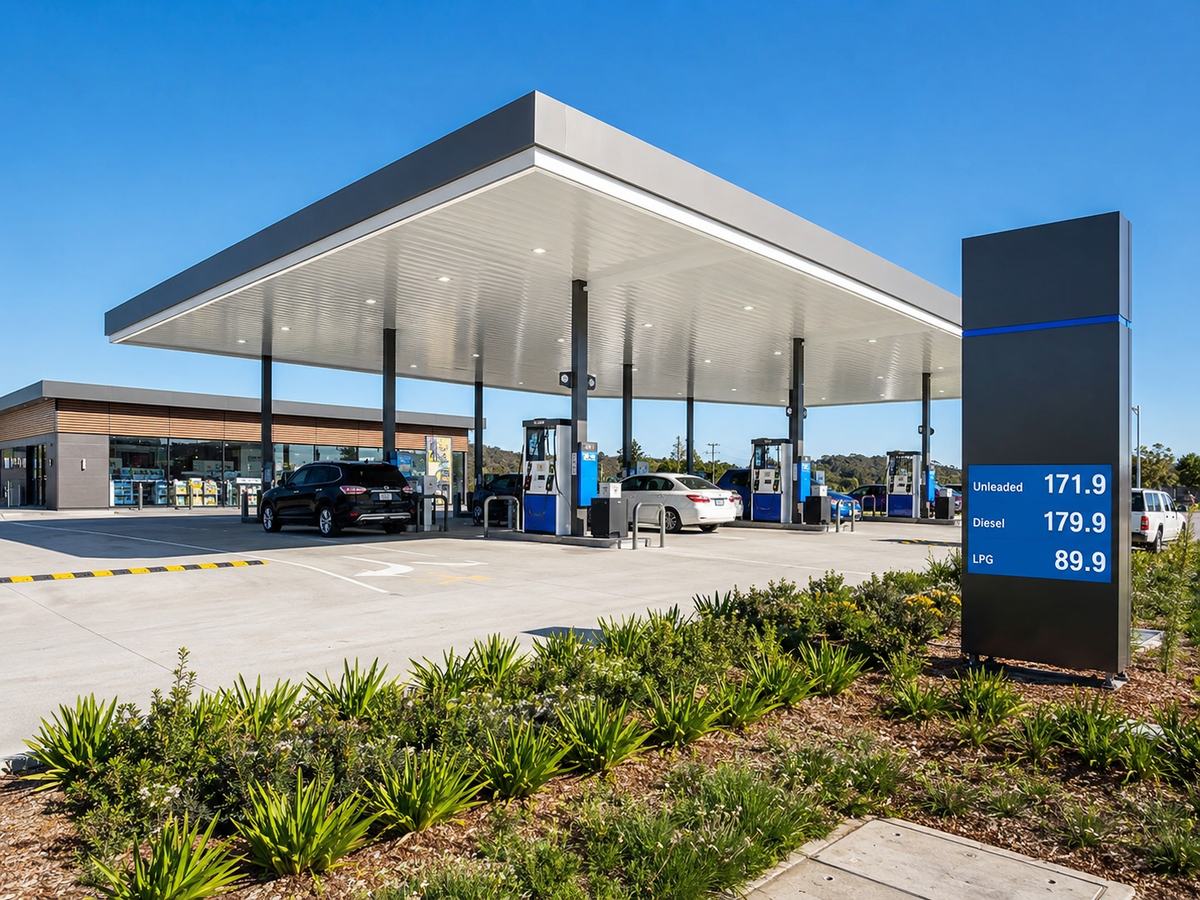
What changes the funding
A service station is a tenant-driven investment asset. Leverage is set against the completed, leased value — net rent capitalised at a market yield — and the lender underwrites the tenant covenant, lease term and any fuel-supply agreement. Location and environmental due diligence complete the picture.
We build the submission around the lease and covenant evidence so the income case, not just the build cost, carries the funding.
| Valuation basis | Net rent capitalised at a market yield (investment value) |
|---|---|
| Key credit test | Tenant covenant, lease term, supply agreement, environmental |
| Typical leverage | Against completed value and total cost |
| Repaid by | Investment sale or refinance onto a completed-asset facility |
Worked example
A service station and QSR pad valued at an $8.5m completed value on capitalised fuel and shop rent. Senior debt is set against that value and the build cost.
| Layer | Amount | % of cost |
|---|---|---|
| Senior debt @ 8.50% | $4.09m | 65% |
| Developer equity | $2.20m | 35% |
| Total development cost | $6.29m | 100% |
| Completed value | $8.50m |
|---|---|
| Loan to value (LVR) | 48.1% |
| Loan to cost (LTC) | 65.0% |
| Cost of debt | 8.50% |
| Finance cost (interest) | $347,429 |
| Brokerage — BluCow (indic.) | $40,874 + GST |
| Development profit | $2.08m |
| Margin on cost | 33.1% |
| Return on equity | 94.7% |
| Equity multiple | 1.95x |
Illustrative only — actual leverage, pricing and returns depend on the lender, valuation, QS report and the specific project.
When it's the right structure
Service station finance suits developers delivering to a pre-committed retailer lease and holding or trading the completed investment. A strong covenant and supply agreement produce the sharpest funding.
Advantages and limitations
Advantages: leverage tied to a leased investment value backed by a strong tenant, with no for-sale presale risk. Limitations: covenant-dependent, environmentally sensitive, and reliant on a narrower specialised-asset market.
Related services
- Property development finance (overview) →
- Childcare centre development finance →
- Commercial development finance →
Frequently asked questions
How are service stations valued for finance?
As an investment: the net rent under the retailer's lease capitalised at a market yield. The tenant covenant, lease length and any fuel-supply arrangement drive the completed value — and therefore the leverage — far more than construction cost.
Does the fuel supply agreement matter to lenders?
Yes. A supply agreement and a strong national or well-rated retailer tenant underpin the income and the covenant, which is exactly what the lender is advancing against. Weaker covenants tighten leverage and pricing.
Are there extra considerations for service stations?
Environmental due diligence (fuel storage and contamination) is a standard part of the credit process, alongside the lease, tenant covenant and site location. We factor these into how the submission is prepared.