

What changes the funding
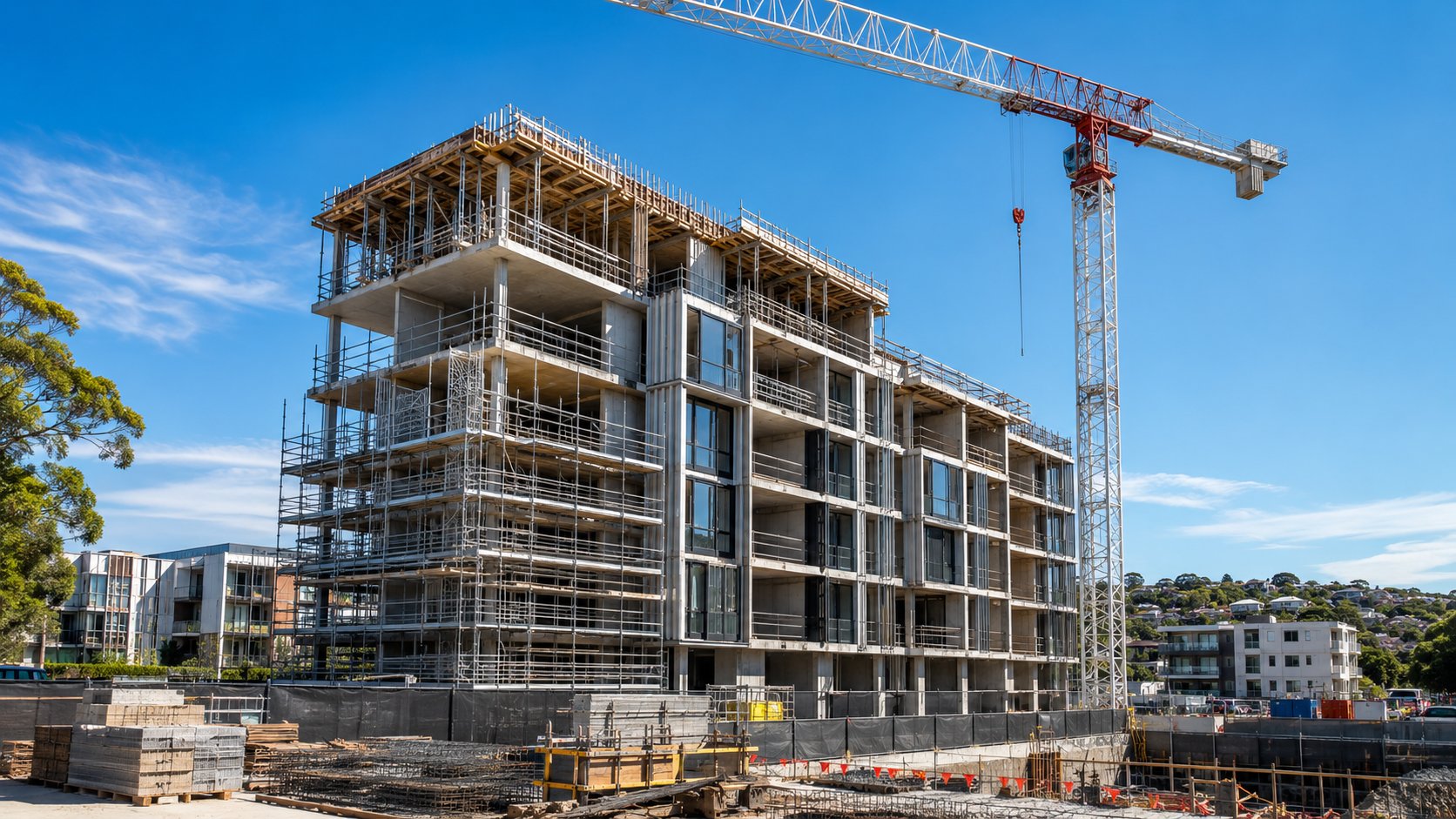
An apartment development concentrates the whole project into a single structure delivered by one head contractor. That shapes the funding in three ways: leverage is driven by gross realisation and total cost; presales often underpin the senior facility; and the builder becomes the single biggest credit item, because there is little to substitute mid-build if the contractor fails.
BluCow packages the submission to defend the maximum sensible senior position, then layers mezzanine or preferred equity only where the margin justifies the cost of the extra leverage.
| Typical leverage | Lower of ~65% of GRV and ~80% of total cost |
|---|---|
| Presales | Often required for bank senior; reduced/none via private credit at higher cost |
| Key credit test | Builder capability, fixed-price contract and margin headroom |
| Repaid by | Settlement of presold and completed stock, or a completion refinance |
Worked example
A 42-apartment mid-rise with a $23.0m end value. Senior debt is set by the lower of the GRV and cost tests; a modest mezzanine layer preserves the developer's cash for the next site.
| Layer | Amount | % of cost |
|---|---|---|
| Senior debt @ 8.25% | $11.50m | 68% |
| Mezzanine @ 15.50% | $1.52m | 9% |
| Developer equity | $3.89m | 23% |
| Total development cost | $16.91m | 100% |
| End value (GRV) | $23.00m |
|---|---|
| Loan to value (LVR) | 56.6% |
| Loan to cost (LTC) | 77.0% |
| Blended cost of debt | 9.10% |
| Finance cost (interest) | $1,184,622 |
| Brokerage — BluCow (indic.) | $126,467 + GST |
| Development profit | $5.63m |
| Margin on cost | 33.3% |
| Return on equity | 144.7% |
| Equity multiple | 2.45x |
Illustrative only — actual leverage, pricing and returns depend on the lender, valuation, QS report and the specific project.
When it's the right structure
Apartment finance suits developers delivering density on a single title, where scale justifies the presale and builder scrutiny. Where the equity gap above senior is large, mezzanine or preferred equity closes it without surrendering a share of the project.
Advantages and limitations
Advantages: scale efficiency, strong GRV against cost, and a clear presale-driven repayment path. Limitations: builder-risk concentration, presale conditions, and margins that must absorb a full QS-tested cost-to-complete.
Related services
- Property development finance (overview) →
- Townhouse development finance →
- Land subdivision finance →
Frequently asked questions
How much can I borrow for an apartment development?
Senior debt is typically capped at the lower of a percentage of gross realisation (around 65% of GRV) and a percentage of total development cost (around 80% of TDC). Stretch senior or mezzanine can lift total leverage further where the margin supports it.
Do I need presales to fund an apartment build?
Bank senior usually requires qualifying presales to cover a portion of the debt; private-credit senior can reduce or remove that requirement at a higher cost. Credit teams look at the quality of presales — arm's-length buyers on full deposits — not just the headline number.
What do lenders scrutinise most on apartments?
Builder-risk concentration. An apartment build is one structure, one crane and one head contractor, so the builder's balance sheet, track record and fixed-price contract carry the most credit weight, alongside a development margin comfortably above 15% on cost.